


Adams Morgan Aims for More Than Just Nightlife
Adams Morgan has changed significantly over the last 50 years from the time it was commonly known as the upscale residential neighborhood, Lanier Heights. Today it's now taken on a new role as an up and coming neighborhood that's currently largely Hispanic immigrants but is quickly being gentrified by professionals.
In 1955 two elementary schools that had been previously segregated, were now successfully integrated into one school paving the way for others to follow in the district. The school’s names’ were John Quincy Adams Elementary School and Thomas P. Morgan Elementary School. Morgan, an all-black school eventually closed as black and white students were ushered into John Quincy Adams.
The integration of the two schools gave way to the neighborhoods current name, the Adams-Morgan Community Council was formed, and the city redrew boundaries that combined existing neighborhoods, Washington Heights, Lanier Heights, and Meridian Hill. A wave of development during the 1980s helped push up property values in the area, yet Adams Morgan has still been able to maintain its unique identity.
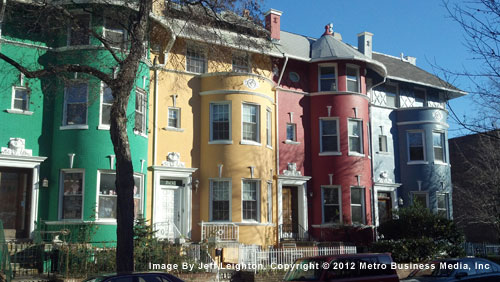
Today, Adams Morgan is served by its own metro stop, several bus lines, numerous Zip Cars, countless bike racks and a very pedestrian friendly lay out. The area is bounded by Harvard Street to the North, Florida Avenue to the South, 16thStreet to the East, Rock Creek Park to the West, and Connecticut Ave to the Southwest. it still attracts a diverse assortment of people; it just depends on what day you are talking about. But when the weekend rolls around the area is at its best, particularly along its main strip on 18th street, where historic row houses have been converted into restaurants, bars and clubs. The area can get packed with lots of area residents coming to the bar and nightclub scene. However, outside of the nightlife strip there are also plenty of attractions including a variety of restaurants, specialty shops, coffee houses, and mom and pop shops. Some of the ethnic restaurants include Caribbean, Ethiopian, Vietnamese, Latin American.
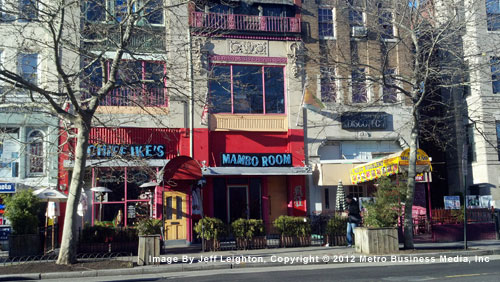
A few of the must go to stores in the area include The Tryst(coffee), Pasta Mia for great Italian food, and Mezewhich has an amazing brunch and tapas. Overall Adams Morgan is a must see for visitors as the diverse mix of commercial, retail, residential options, and people is keeps its unique identity in the nation's capital.
During the week Adams Morgan is not nearly as busy due to its primarily residential and retail make up. Patrons can take a bike or walk through the very pedestrian friendly neighborhood to check out all the unique stores and row houses. Local farmers markets offer a wide selection of authentic food and crafts. Many people love Adams Morgan because of its great mix of urban renewal while keeping its historic city features; professional residents would describe the area as eclectic. There is also a variety of housing available including row houses, converted row houses that are now rentals and a wide selection of mid-rise condos and apartments. In addition to niche stores throughout Adams Morgan there are a few anchor stores including a Safeway and Harris Teeter.
The big news in Adams Morgan is a proposed boutique hotel project by developer Brian Friedman. Friedman's Company, Friedman Capital Advisors, LLC has teamed up with national hotel developer Beztak Companies to form Adams Morgan Church Hotel, LLC. The hotel is expected to be 10 stories and cost over $100 million to develop. Friedman is also partnering with Bethesda-based Marriot International in developing the project. Marriot would help with management of the property but keep its independent feel. The lead architect Gary Handel has completed some impressive projects across the globe spanning from Hong Kong to Abu Dhabi. The development would be located on the former City Paper Building site on Chaplain St NW and so far has already gone through a lengthy process for approval, with potentially more to go. The delay is in large part due to opposition from some residents and political figures alike. A hotly contested $46 million tax abatement the hotel would receive was challenged by opponents, citing the tax abatement as unnecessary for a luxury hotel and that the project didn’t meet some building requirements, including building heights above the maximum 90 ft for the area, roof design issues, and inaccurate drawings. However, with all that being said it is not uncommon for buildings to change as they go through different phases of zoning and building requirements. The estimated amount of jobs that will be created according to Friedman would be at least 1500 just in construction and there would be an emphasis on providing jobs and apprenticeship opportunities to the local community. Friedman also plans on building a community center of about 4000 square feet. Despite the hurdles, the boutique hotel project is moving forward with next, including zoning commission approval and possibly federal review.
- Real Estate/Lodging/Green
- Washington
- FEATURED
- Adams Morgan Church Hotel LLC
- Adams Morgan, Washington, D.C.
- Alliance
- Company Location
- elementary school
- Employment Relation
- Friedman Capital Advisors LLC
- Gentrification
- Human geography
- John Quincy
- John Quincy Adams
- Lanier Heights
- Lanier Heights, Washington, D.C.
- Meridian Hill
- Morgan is
- Person Career
- Quincy Adams
- Quincy, Massachusetts
- Technology
- The hotel
- Thomas P. Morgan
- Washington
- Washington

Stocks, Trading and Investing


Copyright © 2011-2012 Metro Business Media, Inc